

ROOT
-
-
September 18, 2026
Flock Yeah: Australia's Biggest Birdwatching Week Is Back
Spring is well and truly in the air across Australia. The wattlebirds are back at the grevilleas, the rainbow lorikeets are squabbling over blossoms, and somewhere in a park near you, a magpie is perfecting its morning aria (or practising its swooping technique like Nick Daicos). Every October, for one glorious week, the rest of the country catches up with what bird lovers already know: our feathered neighbours are extraordinary, and they deserve a closer look.
Running from October 19th to 25th, 2026, National Bird Week is a celebration of Australia's incredible avian diversity. Whether you’re a seasoned birder or someone who just enjoys a magpie’s warble (or Magpies football highlights) with your morning coffee, National Bird Week is the perfect excuse to slow down and look up.
What Is National Bird Week?
National Bird Week is BirdLife Australia's flagship annual celebration of the birds we share our continent with. At its heart
-
August 20, 2026
GPO Birdwatching Binoculars
An 8x magnification is the undisputed global recommendation for birdwatching. It limits erratic handheld handshake while expanding your view to track small, fast flight paths. German Precision Optics (GPO) leverages extra-low dispersion (ED Glass) inside a lightweight magnesium alloy chassis to eliminate chromatic aberration (purple edge bleeding), revealing sharp feather markings in thick canopy shade
GPO Passion ED 8x32 Binoculars
- Price: $749.95
- Best For: Lightweight bushwalking, active trail hiking, and all-day birding on the move.
- Standout Feature: The absolute most travel-friendly model in GPO's fleet, tipping the scales at a mere 520 grams while retaining a robust, weatherproof magnesium core.
- Key Specs: Formed with an ergonomic microbridge design, it pulls in a 90% ISO-certified light transmission rate and focuses down to 2 metres for close-range garden birds.
GPO Passion ED 8x42 Binoculars
- Price: $849.95
- Best For: Low-light woodland observation,
-
August 11, 2026
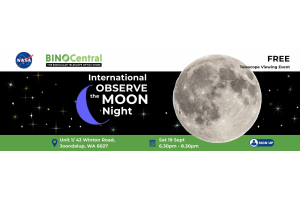
Join us for an evening under the Moon!
Celebrate International Observe the Moon Night with us at BinoCentral on Saturday, 19th September for a special evening of lunar observing, telescopes and astronomy!
Whether you’re a seasoned stargazer, looking to get started in astronomy, or simply want to give the kids an unforgettable look at the Moon, everyone is welcome.
As the Sun goes down, we’ll turn our telescopes towards our closest celestial neighbour and explore the incredible landscape of the Moon up close.
LOOK THROUGH TELESCOPES
See the Moon for yourself through a range of telescopes and discover just how much detail is hiding 384,000 km away.
Explore enormous impact craters, vast lunar plains, towering mountains and shadows stretching across the lunar surface.
DISCOVER THE MOON
Learn more about what you’re seeing and discover some of the Moon's most fascinating features.
Our team will be on hand throughout the evening to help identify lunar landmarks, answer your astronomy questions
-
August 03, 2026
A Binoculars Guide for Melbourne’s NFL Debut on September 11th 2026
There’s history in the making this September, and it’s happening right here in Melbourne.
On Friday 11th September 2026, Melbourne will experience a sporting milestone as two of the NFL’s fiercest NFC West powerhouses, the San Francisco 49ers and the Los Angeles Rams, will run onto the hallowed turf of the Melbourne Cricket Ground for what will be the first-ever NFL regular season game played on Australian soil.
Kick-off is set for 10:35am AEST, and with the MCG capable of hosting more than 100,000 spectators, the atmosphere promises to be electric in this once-in-a-lifetime morning spectacle that is expected to draw massive crowds of diehard fans in Australia.
But here’s something many fans don’t realise, to truly appreciate the tactical chess match of an NFL game, whether it’s the tight spirals, the sideline catches, or the blitzes, you need a view that puts you right on the 50-yard line, even if your seat is in the
-
July 24, 2026
FREE EVENT – DISCOVER THE MICRO WORLD!
An Incredible Hands-On Microscope Adventure for Kids & Families!
There’s an entire hidden world all around us… and you’re invited to discover it!
Join us on 15th August for an exciting 1-hour journey into the microscopic world, where curious young explorers will get hands-on with microscopes and see everyday objects in ways they’ve never seen before!
Come face-to-face with incredible bugs and discover the tiny details hiding on their wings, legs and bodies.
Journey deep inside rocks and minerals to uncover amazing colours, crystals, textures and patterns invisible to the naked eye.
Get hands-on with real microscopes and learn how to zoom into a world that normally goes completely unseen.
Take on fun microscope activities and challenges designed to get young minds thinking, exploring and discovering!
Expect plenty of "WOW!" moments as ordinary objects transform into extraordinary microscopic landscapes right before your eyes.
Perfect
-
July 23, 2026
On the first wednesday of June, AGWA will be holding the monthly AGWA meeting at BinoCentral, doors open at 7:00PM, Meeting is from 7:30PM - 9:00PM. Checkout the AGWA Facebook group for more info.
-
June 26, 2026
Don't Settle for the Nosebleeds: See Every Tackle at the 2026 Sydney Super Cup
You’ve secured your seat for the Sydney Super Cup, but let’s face it: from the top tier of Accor Stadium, even superstars like Cole Palmer or Xavi Simons can look like moving dots. Don't let distance dampen this historical, heated rivalry between North London and West London.
For supporters, sports travellers, and football tourists alike, this is a once-in-a-lifetime chance to witness Premier League intensity live in Australia. The right viewing gear can help elevate the experience for anyone travelling to Sydney's stadiums.
Whether you're in the front row or the nosebleeds, explore this definitive guide to the August 1st showdown and let us help you discover the best binoculars to bring the pitch-side action directly to your eyes.
Match Spotlight: Chelsea vs.Tottenham Hotspur
- Date: Saturday, 1 August 2026
- Venue: Accor Stadium, Sydney Olympic Park
- Kick-off: 7:45 PM AEST
For the first time in history, these two
-
June 08, 2026
Apollo 11 Moon Landing Mission, image credit: San Juan College
One Giant Leap, 57 Years Later: Why Apollo 11 Still Matters
Imagine watching a grainy black-and-white screen, holding your breath, as two human beings took their first steps on another world.
On a quiet July evening in 1969, an estimated 600 million people — one-fifth of the entire global population at the time – gathered around televisions, radios, and newspaper bulletins to witness something that had never happened before in human history. For the first time, human beings were about to set foot on the Moon. What followed would become one of the greatest space exploration milestones of all time: the Apollo 11 moon landing.
As we celebrate the 57th anniversary of Apollo 11, we don’t just remember a historic moment. We revisit a story of courage, innovation, science, and the unstoppable human desire to explore the unknown.
What Was Apollo 11?
Apollo 11 was a NASA mission launched on July 16, 1969, as part of the larger Apollo
-
May 04, 2026
Image credit: NASA Goddard
Super New Moon Returns in June 2026: Here’s What to Know
Missed out on the Super New Moon in May? No need to worry, you'll have a second chance to witness Australia's Super New Moon again when it graces our skies during the nights of June 14 - June 16 2026. This subtle but astronomically significant lunar event won’t be visible in the sky like the last one (new moons never are), but it still plays an important role in understanding lunar cycles, tidal changes, and even the way we observe the Moon from Earth.
This guide explains:
- What a New Moon actually is
- What makes a Super New Moon different
- The real-world effects to expect
- Why missing on isn't a big deal
Let’s break it down.
What Exactly Is a New Moon?
A New Moon happens when the Moon sits directly between the Earth and the Sun. During this alignment:
- The side of the Moon facing Earth is not illuminated.
- The Moon rises and sets roughly with the Sun, meaning it’s only ‘out’ during the day.
- It appears invisible
-
April 06, 2026
May 2026 Super New Moon Australia Guide
Between the nights of May 15 – 17 May 2026, we’ll be experiencing a Super New Moon, a subtle but astronomically significant lunar event. Although it won’t be visible in the sky (new moons never are), it plays an important role in understanding lunar cycles, tides, and even the way we observe the Moon from Earth.
This guide explains:
- What a New Moon actually is
- What makes a Super New Moon different
- The real-world effects you might notice
- Common myths vs scientific reality
Let’s break it down.
What Exactly Is a New Moon?
A New Moon occurs when the Moon sits directly between the Earth and the Sun. During this alignment:
- The side of the Moon facing Earth is not illuminated.
- The Moon rises and sets roughly with the Sun, meaning it’s only ‘out’ during the day.
- It appears invisible or hidden in the night sky.
This phase marks the beginning of the lunar cycle, which lasts about 29.5 days (called a synodic month). In many cultures, the New Moon represents
-
March 05, 2026
Image credit: Australian Geographic
Wake Up to a Rare Three-Planet Alignment This April 2026: A Viewing Guide
If you've ever wanted to spot a planet - but weren't sure where or when to look - this is your moment. Before sunrise on the mornings of 19th - 22nd April 2026, three planets Mercury, Mars, and Saturn will appear close together in the sky, forming a beautiful and eye-catching planetary trio. All you need to do is look toward the east.
No special knowledge is required. No telescope required (but highly recommended if you want a closer and more detailed look). Just clear, unobstructed skies and a few quiet minutes before dawn.
What's Happening?
From our viewpoint on Earth, the planets will appear to bunch together in a small area of sky. This is called a planetary alignment (or scientifically known as triple planet conjunction), and while it doesn’t happen every year, it is always a treat especially when Mercury is involved because it is harder to spot due to the close proximity