

Wake Up to a Rare Three-Planet Alignment This April 2026: A Viewing Guide
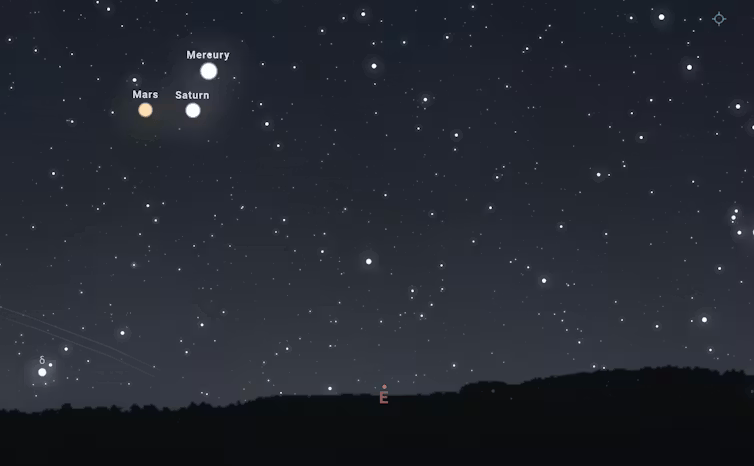
Image credit: Australian Geographic
Wake Up to a Rare Three-Planet Alignment This April 2026: A Viewing Guide
If you've ever wanted to spot a planet - but weren't sure where or when to look - this is your moment. Before sunrise on the mornings of 19th - 22nd April 2026, three planets Mercury, Mars, and Saturn will appear close together in the sky, forming a beautiful and eye-catching planetary trio. All you need to do is look toward the east.
No special knowledge is required. No telescope required (but highly recommended if you want a closer and more detailed look). Just clear, unobstructed skies and a few quiet minutes before dawn.
What's Happening?
From our viewpoint on Earth, the planets will appear to bunch together in a small area of sky. This is called a planetary alignment (or scientifically known as triple planet conjunction), and while it doesn’t happen every year, it is always a treat especially when Mercury is involved because it is harder to spot due to the close proximity of the Sun and its glare.
Seeing three planets grouped together makes them much easier to find and much more exciting to observe.
When and Where to Look
- Dates: April 19th – 22nd 2026
- Time: About 30–60 minutes before sunrise, approximately 5am (AEST)
- Direction: Low in the eastern sky
Find a spot with a clear and unobstructed view of the horizon; an open field, beach, or quiet street without buildings, trees or hills works perfectly. The planets will rise shortly before the Sun, so earlier is better
What Will It Look Like?
You’ll see three bright points of light clustered together:
- Mars - Look for the distinct ruddy, orange-red hue. Though not at its brightest (opposition isn't until 2027), its colour makes it easy to distinguish from the surrounding stars.
- Saturn - Will shine with a steady and pale-yellow light, though you’ll want a telescope to see the rings.
- Mercury - Often the most elusive, it will be lower and closer to the horizon appearing as a bright, yellowish point.
They’ll stand out from the background stars, especially during the deep blue of early dawn. A small - medium sized telescope can greatly enhance the view, but they’re not necessary as this alignment will be visible to the naked eye.
Best Optics to Use
For the best possible viewing experience, especially for the curious minds who want to get a closer and detailed look of Mars, Mercury, or Saturn, here are some recommended ways to view this celestial phenomenon and how they work:
- The Naked eye: Plain and simple, you'll be able to see the bright spots in the sky easily
- Refractor Telescopes: Uses lenses at the front to bend (refract) light to a focal point
- Reflector Telescopes: Uses mirrors (primary and secondary) to reflect light to the eyepiece
- Dobsonian Telescopes: A more accessible and simpler reflector telescope as it comes in two pieces: optical tube and a Dobsonian base
- Cassegrain Telescopes: Comes in two types; Maksutov-Cassegrain and Schmidt-Cassegrain, ideal for those wanting to get better deep-sky viewing or dive into astrophotography
- Telescope Accessories: Improve your telescope’s image and magnification of the planets with quality eyepieces, Barlow lenses, planet filters, or even a smartphone adapter for taking pictures from your phone
Safety Note: If you are using optical aids, be extremely careful. Stop your observations well before the sun actually breaks the horizon to avoid accidental eye damage.
Pro Tips for Viewing
- Check the weather forecast and plan for the clearest morning in your four-day window
- Let your eyes adjust to the darkness for at least 10 minutes before viewing
- Use a compass or smartphone app to confirm you're looking due east
- Dress warmly as pre-dawn temperatures can be surprisingly chilly, even in April
- Bring a red flashlight if you need light, it preserves your night vision better than white light
Don't let this opportunity pass you by. Set your alarm, grab your telescope, and witness this beautiful planetary convergence. It's moments like these that make astronomy so captivating, a reminder that some of the most spectacular shows in the universe are completely free and just waiting for us to look up.
Clear skies and happy observing!
Still need more advice on telescopes? Give us a call! (08) 6108 4239 or email us at support@binocentral.com.au.