

A Rare International 6-Planet Parade is Coming: When and Where to Look in February 2026
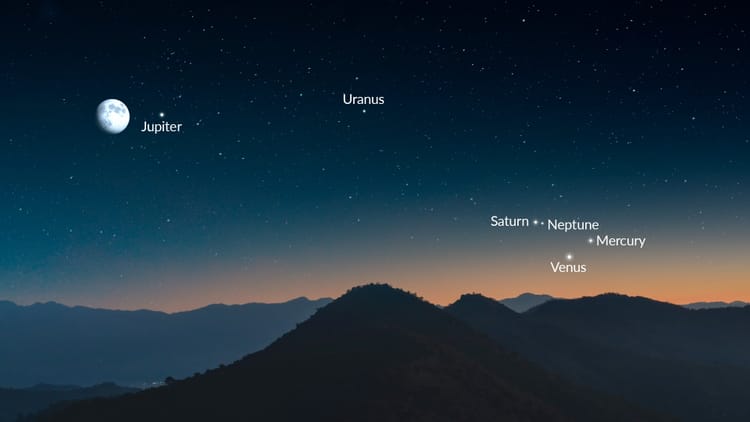
Northern Hemisphere 6-planet alignment on 28th February 2026, image credit: Star Walk © Vito Technology, Inc.
A Six-Planet Parade Lights Up the Northern Hemisphere Sky on February 28, 2026
If you happen to be overseas on February 25th – March 2nd 2026, you wouldn’t want to miss a rare and exciting chance to witness a striking planetary alignment parade as six planets will appear grouped along the same region of the Northern Hemisphere sky: Mercury, Venus, Saturn, Jupiter, Uranus, and Neptune. Such a rare celestial event won't occur again until 2040.
What is a Planetary Alignment
A planetary alignment occurs when multiple planets appear grouped along the same region of sky as viewed from Earth. This happens because all planets in our solar system orbit the Sun along roughly the same flat plane. called the ecliptic. From our perspective, this makes them appear strung out along a gentle arc across the sky rather than scattered in a cluster.
The February 2026 planetary parade is especially significant because it involves six planets visible within a concentrated timeframe - an occurrence that happens only once every 14-16 years.
Which Planets Will You See in the February 2026 Alignment?
- Venus and Jupiter: will be the brightest and easiest to spot with the naked eye. Venus appears as a white 'evening star', while Jupiter shines with a steady, cream-coloured glow.
- Saturn: will appear with a soft and steady golden-yellow hue. You can see its famous rings through binoculars or a telescope.
- Mercury: will sit low near the horizon and may be harder to catch as it sets quickly after sunset. Visible with the naked eye but requires a clear view and good timing.
- Uranus: appears as a faint blue-green disc, will require binoculars or a telescope to spot it.
- Neptune: requires a telescope to see it as it is the faintest of the group and will appear as a tiny blue dot.
While the planets won’t form a perfect line, seeing this many gathered at once is a great visual demonstration of how our solar system is arranged.
When to See the Planetary Alignment: Best Dates, Times, and Location
While February 28 is the peak date for the 'perfect' alignment for many people around the world, the actual date varies by geographic location. You’ll likely get a great view a few days before or after the 28th as the planets shift into their tightest formation.
If you find yourself visiting these countries and cities during this rare event, check out the dates to make sure you won’t be on the wrong end of the timeline.
Optimal Viewing Times
Best viewing window: 30 - 60 minutes after local sunset
Viewing duration: Approximately 45 - 90 minutes before Mercury Sets
Peak Viewing Dates by Major City
- Brazil, São Paulo: February 25
- Greece, Athens: February 28
- United States of America, New York: February 28
- Mexico, Mexico City: February 28
- Japan, Tokyo: February 28
- China, Beijing: March 1
- Germany, Berlin: March 1
- England, London: March 1
- India, Mumbai: March 1
- Iceland, Reykjavík: March 2
How to See the Planetary Alignment: Complete Viewing Guide
Follow these expert tips to maximise your viewing experience and ensure you don't miss this rare astronomical event:
1. Choose Your Viewing Location Carefully
- Find a clear western horizon: Tall buildings, trees, and mountains can block your view of Mercury, Venus, and Saturn, which will appear low in the west
- Minimise light pollution: Move away from city lights when possible for better or views of fainter planets
- Check weather forecasts: Clear skies are essential - plan ahead and have backup dates
2. Use the Right Equipment
- Naked eye: Sufficient for Venus, Jupiter, Sturn, and Mercury
- Binoculars (10x50 or 15x70): Essential for spotting Uranus; enhances views of all planets
- Telescope: Required for Neptune; reveals details like Saturn's rings and Jupiter's moons
- Astronomy app: Use apps like SkySafari, Stellarium, or Star Walk to identify planets and track the ecliptic path
3. Follow the Ecliptic Path
The planets will appear strung along the ecliptic, the path that the Sun follows aross the sky. Look for a diagonal 'necklace' of lights stretching from the western horizon upward and across the sky, not a perfectly straight vertical line as sometimes depicted in news headlines or illustrations
4. Allow Time for Dark Adaptation
Spend at least 10-15 minutes in darkness before serious planet hunting. This allows your eyes to become more sensitive to fainter objects like Uranus and helps you spot subtle colour differences between planets.
5. Start with the Brighest Planets
Begin by locating Venus or Jupiter, the two brightest objects. Once oriented, work your way to the fainter planets. This helps you confirm you're looking in the right direction.
Why It’s Worth Watching
- Rare occurrence: Six-planets alignments with this level of visibility happen approximately once every 14-16 years. The next comparable event won't occure until 2040.
- Educational opportunity: Perfect for beginners interested in astronomy, offering a chance to identify multiple planets and practice using star charts and apps.
- Visual demonstration of solar system structure: Seeing all these planets gathered together provides a tangible sense of how our solar system is organised,
- Excellent for astrophotography: Creates stunning wide-field photo opportunities capturing multiple planets in one frame.
Frequently Asked Questions About the Planetary Alignment
Will the planets form a straight line?
No. Despite what some illustrations show, the planetary parade will appear as a diagonal arc or 'necklace' across the sky, not a vertical or perfectly straight line. The planets follow the ecliptic, which appears as a curved path from our perspective on Earth.
Can I see this from the Southern Hemisphere?
This particular alignment is optimised for Northern Hemisphere observers. While some planets may be visible from southern locations, the viewing conditions and timing will be significantly different and less favourable.
What if I miss the peak date?
Don't worry! The planets will remain in a relatively tight grouping for approximately two weeks before and after February 28, 2026. If weather doesn't cooperate on the peak date, try viewing a dew days earlier or later.
Do I need special equipment?
Not necessarily. Four planets (Mercury, Venus, Saturn, and Jupiter) are visible with the naked eye. However, binoculars or a telescope significantly enhance the experience and are required to see Uranus and Neptune.
Is this event dangerous to observe?
Not at all. Unlike solar eclipses, planetary alignments are completely safe to observe with the naked eye, binoculars, or telescopes. The planets are simply reflecting sunlight and they don't emit harmful radiation.
When is the Next Planetary Alignment?
After the February 2026 event, the next six-planet alignment with comparable visibility won't occur until 2040. However, smaller alignments featuring 3-4 planets happen more frequently
- Three-planet alignments occur several times per year
- Four-planet alignments happen approximately once every 1-2 years
- Five-planet alignments occur roughly every 3-5 years
This makes the 2026 six-planet parade particularly special and worth witnessing if you have the opportunity.
If this piques your interest and you would like to know more about astronomy, binoculars or telescopes, give us a call! (08) 6108 4239 or email us at support@binocentral.com.au.