

Mackenzie Palmer
-
-
August 20, 2026
GPO Birdwatching Binoculars
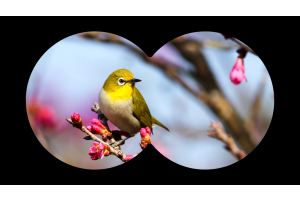
An 8x magnification is the undisputed global recommendation for birdwatching. It limits erratic handheld handshake while expanding your view to track small, fast flight paths. German Precision Optics (GPO) leverages extra-low dispersion (ED Glass) inside a lightweight magnesium alloy chassis to eliminate chromatic aberration (purple edge bleeding), revealing sharp feather markings in thick canopy shade
GPO Passion ED 8x32 Binoculars
- Price: $749.95
- Best For: Lightweight bushwalking, active trail hiking, and all-day birding on the move.
- Standout Feature: The absolute most travel-friendly model in GPO's fleet, tipping the scales at a mere 520 grams while retaining a robust, weatherproof magnesium core.
- Key Specs: Formed with an ergonomic microbridge design, it pulls in a 90% ISO-certified light transmission rate and focuses down to 2 metres for close-range garden birds.
GPO Passion ED 8x42 Binoculars
- Price: $849.95
- Best For: Low-light woodland observation,
-
August 11, 2026
Join us for an evening under the Moon!
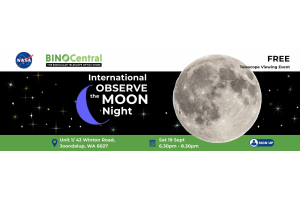
Celebrate International Observe the Moon Night with us at BinoCentral on Saturday, 19th September for a special evening of lunar observing, telescopes and astronomy!
Whether you’re a seasoned stargazer, looking to get started in astronomy, or simply want to give the kids an unforgettable look at the Moon, everyone is welcome.
As the Sun goes down, we’ll turn our telescopes towards our closest celestial neighbour and explore the incredible landscape of the Moon up close.
LOOK THROUGH TELESCOPES
See the Moon for yourself through a range of telescopes and discover just how much detail is hiding 384,000 km away.
Explore enormous impact craters, vast lunar plains, towering mountains and shadows stretching across the lunar surface.
DISCOVER THE MOON
Learn more about what you’re seeing and discover some of the Moon's most fascinating features.
Our team will be on hand throughout the evening to help identify lunar landmarks, answer your astronomy questions
-
July 24, 2026
FREE EVENT – DISCOVER THE MICRO WORLD!
An Incredible Hands-On Microscope Adventure for Kids & Families!
There’s an entire hidden world all around us… and you’re invited to discover it!
Join us on 15th August for an exciting 1-hour journey into the microscopic world, where curious young explorers will get hands-on with microscopes and see everyday objects in ways they’ve never seen before!
Come face-to-face with incredible bugs and discover the tiny details hiding on their wings, legs and bodies.
Journey deep inside rocks and minerals to uncover amazing colours, crystals, textures and patterns invisible to the naked eye.
Get hands-on with real microscopes and learn how to zoom into a world that normally goes completely unseen.
Take on fun microscope activities and challenges designed to get young minds thinking, exploring and discovering!
Expect plenty of "WOW!" moments as ordinary objects transform into extraordinary microscopic landscapes right before your eyes.
Perfect
-
July 23, 2026
On the first wednesday of June, AGWA will be holding the monthly AGWA meeting at BinoCentral, doors open at 7:00PM, Meeting is from 7:30PM - 9:00PM. Checkout the AGWA Facebook group for more info.
-
January 12, 2026
Defending Earth: Inside the Planetary Defence Frontier with Associate Professor David Coward.
Are we ready for the next Chelyabinsk?How do we find “City Destroyers” before they find us?
Find out more at the Perth Observatory Website
-
November 03, 2025
Taurids Meteor Shower
Time: Night of 4 Nov, best 12:00–4:00 am AEST
The Taurids are a slow burner, with 5–10 meteors per hour, coming from Asteroid 2004 TG10 and Comet 2P Encke.Unfortunately, the full moon will hide most meteors this year, but patient stargazers may catch a few bright ones.
Meteors radiate from Taurus, though they can appear anywhere. Best viewed from dark locations away from city lights.
The Leonid Meteor Shower Peaks
The Leonids are back, sprinkling up to 15 shooting stars per hour across the sky at their peak.
The shower comes from dusty debris left behind by Comet Tempel-Tuttle, first spotted in 1865, and runs from 6–30 November, peaking overnight on the 17-18th.
They’re famous for their occasional “storm years” every 33 years or so, when the sky absolutely erupts with hundreds of meteors an hour – the last big one was in 2001.
While we’re not due for that kind of cosmic fireworks this year, 2025 is still shaping up nicely.
The good news? A slim crescent
-
August 22, 2025
Perth’s Total Lunar Eclipse: How to See the Blood Moon on 7 September 2025
Perth is in the box seat for a total lunar eclipse on Sunday night, 7 September 2025—a classic “blood moon” that anyone can enjoy with a telescope, binoculars or even the naked eye. Below is your easy guide: what’s happening, when to look, where to face, and how to capture it.
Timeline (AWST, Perth)
- Penumbral starts: 11:28 pm Sun 7 Sep
- Partial eclipse starts: 12:27 am Mon 8 Sep
- Totality: 1:30 am – 2:52 am (peak 2:11 am)
- Partial ends: 3:56 am • Penumbral ends: 4:55 am
(All times are local (AWST) for Perth. timeanddate)
Where to look: The Moon starts high in the north-northeast, swings through north into the northwest during totality, and is west–northwest by the end. Altitude drops from ~63° at partial start to ~44° by the end of totality.
How long is totality? About 82 minutes—a nice, leisurely show.
What you’ll see (and why it’s red)
As Earth slips between the Sun and the Moon, our planet’s shadow washes across
-
July 10, 2025
FREE Astronomy Viewing Night!
Hosted by BinoCentral- Thursday, July 31st
- 6:00 PM – 8:00 PM
- Unit 1/43 Winton Road, Joondalup
Join us under the stars for an unforgettable evening of stargazing! Whether you're a seasoned space nerd or just curious about the cosmos, this FREE community event is the perfect way to experience the night sky through telescopes and binoculars with guidance from passionate experts.
- Family-friendly
- Great for beginners
- Bring your questions and curiosity!
Come early, dress warm, and let’s explore the universe together.